

Academic Programs
Programs Available
Montana State University offers a comprehensive range of optics and photonics pathways, from associate’s through Ph.D. degrees, combining foundational science, engineering, and hands-onexperience. These interdisciplinary programs are supported by strong partnerships with industry, research centers, and faculty across campus, preparing students for impactful careers in research, industry, and applied technology.
Contact faculty directly to discuss research before you apply, it's encouraged
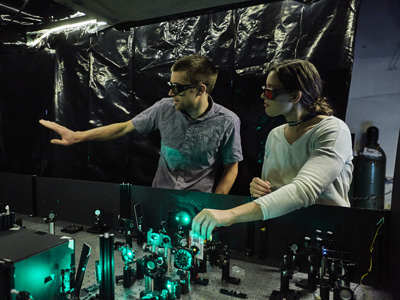
Master of Science in Optics and Photonics
MSU’s Master of Science in Optics and Photonics is an interdisciplinary graduate degree jointly supported by the Departments of Physics, Electrical and Computer Engineering, Chemistry and Biochemistry, and MSU’s interdisciplinary Materials Science graduate program. The program offers both thesis‑based and professional paper options, allowing students to tailor their studies to research or applied career goals.
Learn how to apply and degree requirements
To graduate from this program, you'll need to write a Thesis based on independent research you'll do in the program.
Who it's for
Students who want a research‑intensive experience, are interested in developing original work under faculty mentorship, and are considering research careers, doctoral study, or advanced R&D roles in industry or national laboratories
Career Route
Scientists and Researchers in optics and photonic fields, or pursuing a PhD
This route emphasizes coursework and includes preparing a Professional Paper covering a focused aspect of research, design, or engineering education. Coursework involves two of the participating departments.
Who it's for
Working professionals and application‑focused students who want graduate‑level optics and photonics training that translates directly to industry impact
Career Route
Applied roles across industries such as photonics manufacturing, defense and aerospace, medical devices, telecommunications, semiconductors, energy, and advanced manufacturing
Learn more about the Master of Science Professional Paper Route
Qualified MSU undergraduates may begin coursework toward the M.S. in Optics and Photonics while completing their bachelor’s degree, shortening the time to completion for the graduate degree.
Who it's for
For those who want to finish their master's in less time and pursue employment sooner
Degree Route
Can pursue either the thesis or professional paper route
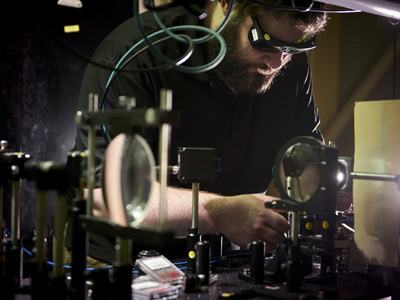
Doctoral Studies in Optics and Photonics
Ph.D. research in optics and photonics is available through several participating departments, including Physics, Electrical and Computer Engineering, and Chemistry and Biochemistry. Students typically pursue optics and photonics research within a disciplinary Ph.D. program.
Who it's for:
Students who want to pursue advanced, original research at the frontiers of light‑based science and technology
Career Route
Research‑intensive industry, national laboratories, or academia
Learn more about the Doctoral Studies in Optics
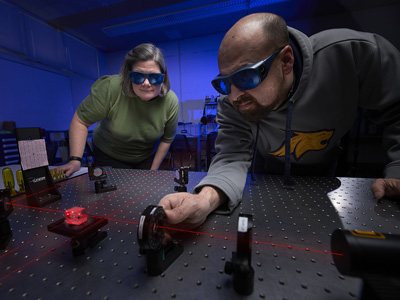
Associate of Applied Science in Photonics and Laser Technology
Offered through Gallatin College MSU, this two‑year applied degree prepares students for technician and technologist roles in photonics, lasers, and related industries, with a strong emphasis on hands‑on training.
Who it's for
Students seeking hands‑on, career‑focused training for entry‑level technician roles in optics, photonics, and laser‑based industries.
Career Route
Immediate employment in manufacturing, communications, medical technology, defense, and related technical fields
Learn more about the Associate of Applied Science in Photonics and Laser Technology

Undergraduate Minor in Optics and Photonics
The Optics and Photonics minor allows undergraduate students to build focused expertise alongside a major in fields such as physics or engineering. The minor emphasizes core concepts in optics, photonics, and electrical engineering.